Async Coaching
How to Turn a Course Into an Async Coaching Offer
You already have the content. Turning a course into async coaching means wrapping it in a check-in, a personalized next step, and accountability, so people actually finish. Here is the step-by-step.
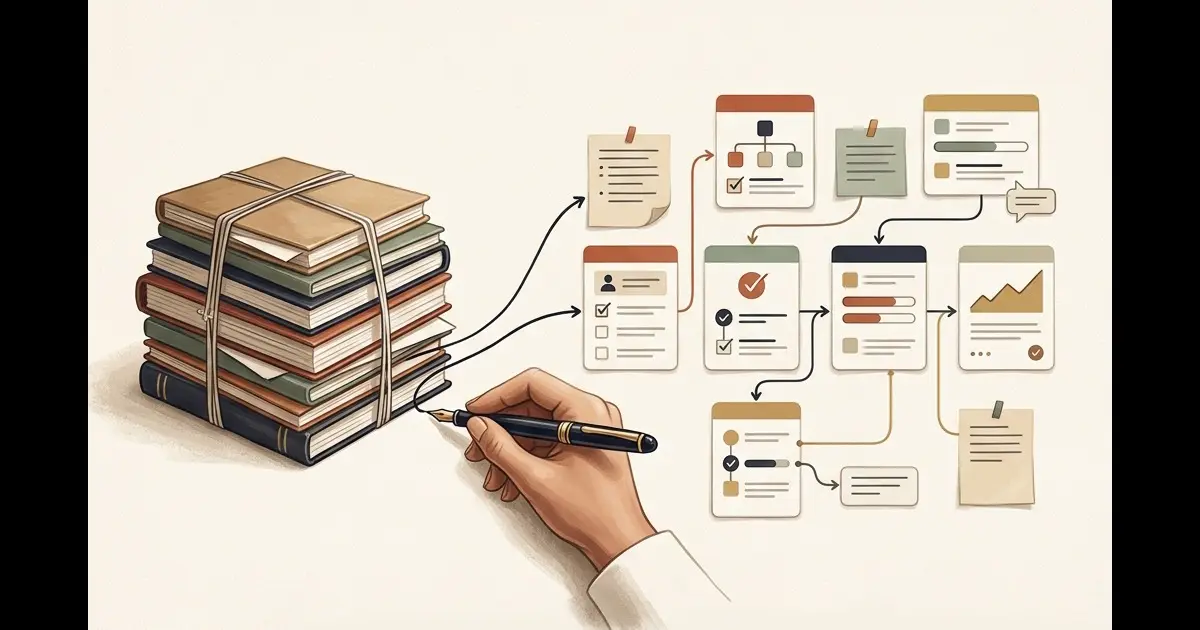
If you have a course, a book, or a body of work, you already own the hard part: the method and the content. Turning it into async coaching does not mean recording everything again. It means wrapping what you have in three things a static course lacks: a check-in, a personalized next step, and accountability.
Here is how to do it without rebuilding from scratch.
Step 1: Start with the highest-friction segment
Do not convert the whole course at once. Find the part that creates the most repetitive support: the onboarding that always takes the same conversation, the module where people get stuck, the homework you review the same way every time. That single segment is your pilot.
Step 2: Design the check-in
Before the client receives that segment, ask a few focused questions, by text or voice: what they are working on, where they are stuck, what they have tried. This is the signal that makes personalization possible, and it is the part most worth getting right. See designing client check-ins.
Step 3: Map your modules to client situations
Your content is not one-size-fits-all, even if it currently ships that way. List the main situations clients arrive in (beginner, stuck-intermediate, high performer needing a small correction) and decide which existing module, example, or exercise fits each. You are not writing new material; you are routing the material you have.
Step 4: Add the personalized next step
Based on the check-in, deliver one next step built for that client: the right module, an audio note in your voice, an adapted exercise. AI can draft and adapt this from your existing content, and you validate what matters. This is the human-in-the-loop part, and it is what keeps the offer yours.
Step 5: Close the loop with accountability
To unlock the next step, the client checks in again. Add a gentle nudge when they go quiet. This rhythm, check in, receive, apply, report, is what turns your low-completion course into something people finish.
The quick checklist
- Pick one high-friction segment to pilot.
- Write 4 to 6 check-in questions.
- Map existing modules to 3 client situations.
- Define the personalized next step and what you validate.
- Add an accountability nudge and a way to unlock the next step.
- Test with a handful of clients, then expand.
Done this way, your old content gets a second life with a much higher completion rate, and you have built the start of a real async coaching offer. For the bigger picture, see what async coaching is and async coaching for course creators.
Frequently asked questions
Do I need to rebuild my course to add async coaching? +
No. The point is to reuse your existing modules, not replace them. You add a thin layer around the content: a check-in before each step, a personalized next step chosen from your material, and an accountability nudge. The teaching you already recorded stays.
How long does it take to convert a course? +
You can pilot one segment in a week or two. Start with the part of your course that creates the most repetitive support, design one async loop around it, and test it with a few clients before expanding to the whole program.
Will it still feel like me? +
Yes, if the voice and method stay yours. The async layer delivers your content adapted to each client; it does not invent new teaching. You validate the important parts, so your judgement and tone stay in the foreground.