Client Experience
Client Check-Ins Are the Heart of Async Coaching
A good async coaching system starts with better client check-ins. The answers create personalization, accountability, and a clearer next step.
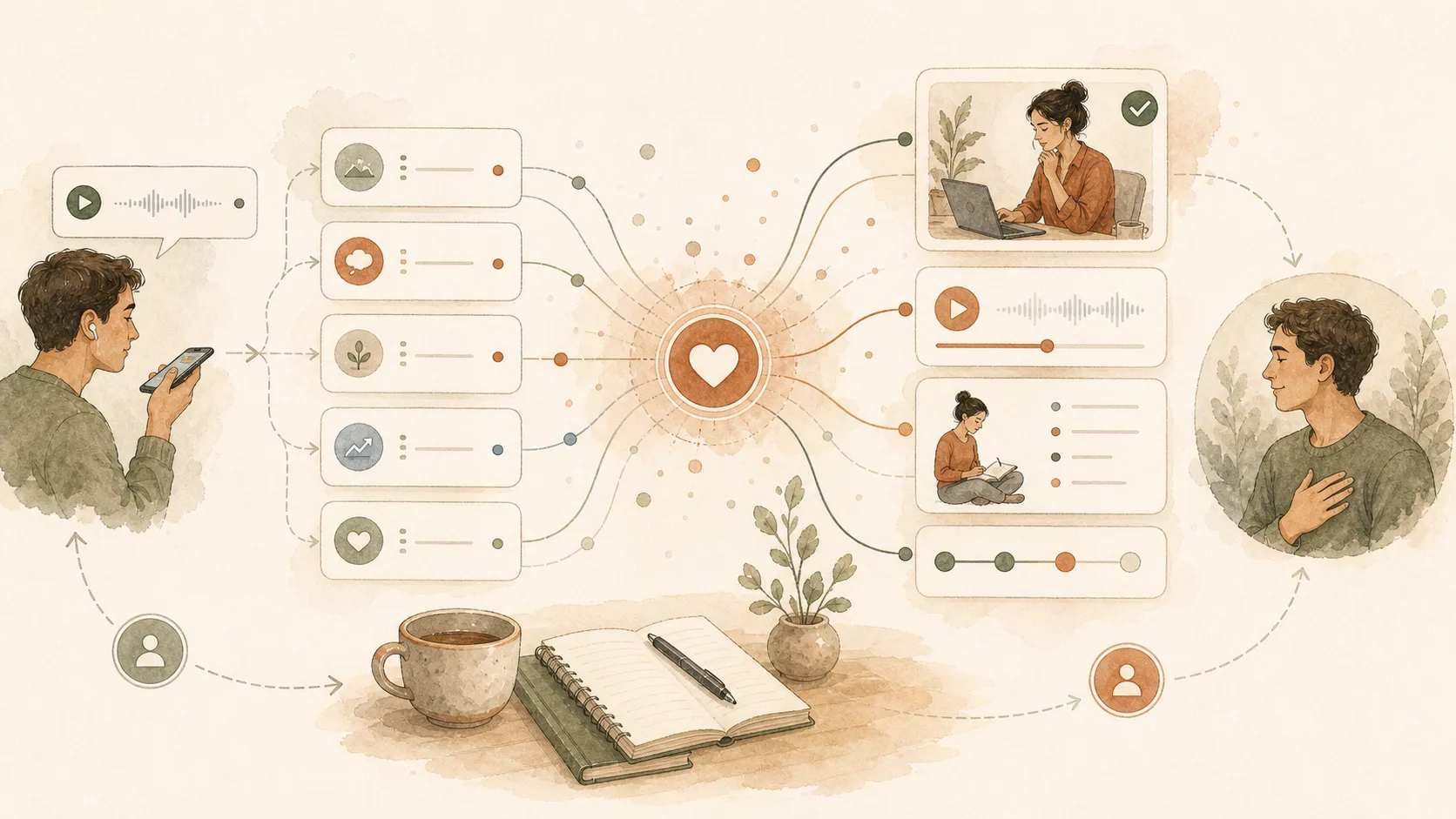
Async coaching does not start with AI.
It starts with a good check-in.
That sounds small, but it changes everything.
Without a check-in, the system has no real context. It can only send the next lesson, the next reminder, or the same generic advice to everyone.
With a check-in, the client gives the raw material for personalization.
They tell you what happened, what they avoided, what felt confusing, what changed, and what they need now.
That is the difference between content delivery and coaching.
A check-in replaces the weakest part of many calls
Many live coaching calls begin with a long warm-up.
The client tries to remember what happened. They explain the week in real time. They circle around the important point. The coach listens for signal inside the story.
Sometimes that is useful.
Often, it is inefficient.
A written or voice check-in gives the client time to reflect before receiving support. It removes the pressure to be clear on the spot. It lets them answer when the experience is still fresh.
It also gives the coach, or the coaching system, a cleaner starting point.
By the time the next session is prepared, the important context is already visible.
The best questions are specific
Bad check-in questions produce vague answers.
“How are you?” is polite, but it rarely creates useful personalization.
Better questions ask for observable details:
- What did you actually do since the last session?
- Where did you stop or avoid the work?
- What felt easier than expected?
- What felt heavier than expected?
- What question keeps repeating in your mind?
- What would make the next step feel doable?
The goal is not to collect a diary.
The goal is to find the next useful move.
Do not ask too much
There is a temptation to turn the check-in into a long intake form.
That usually fails.
If the client needs 25 minutes to answer before every session, the check-in becomes another piece of homework they can avoid.
A good async coaching check-in is short enough to complete and sharp enough to matter.
For most programs, five questions is plenty.
For sensitive or complex work, you may need more. But each question should earn its place.
If you do not use the answer to personalize the next step, remove the question.
The check-in should shape the response
Clients quickly notice when their answers disappear into a void.
If they write something vulnerable and receive the same generic module anyway, trust drops.
The response does not need to mention every answer, but it should clearly adapt.
For example:
- If the client is overwhelmed, the next step should become smaller.
- If the client is avoiding, the response should name the avoidance kindly and directly.
- If the client succeeded, the response should reinforce what worked.
- If the client misunderstood the method, the response should correct the frame.
- If the client raises a sensitive issue, the system should route it to human review.
That is why a real AI coaching platform needs more than chat. It needs a way to transform client context into a better next session.
Use check-ins for accountability, not surveillance
Accountability can become heavy if it feels like monitoring.
The client should not feel policed.
The tone is closer to:
We are keeping the thread alive.
That means noticing when someone disappears, asking a small question, and helping them restart without shame.
The best check-ins make progress visible.
They show the client:
- You are still in the process.
- Your answer matters.
- The next step is based on your real situation.
- You do not need to perform insight. You only need to answer honestly.
This is one reason information products need async coaching. Information alone does not keep the thread alive.
A simple check-in structure
For many programs, this structure is enough:
- What did you do since the last session?
- What got in the way?
- What changed in your understanding, behavior, or body?
- What do you want help with today?
- How much capacity do you have for the next step?
That last question matters.
A high-capacity client may need a challenge.
A low-capacity client may need a tiny step they can actually complete.
Both clients can be in the same program, but they should not always receive the same next action.
Voice answers can be powerful
Text is easy to scan and process.
Voice can reveal more.
Some clients explain themselves better out loud. Their tone, pauses, and energy may carry useful information. They may also feel less friction recording a two-minute note than writing a careful paragraph.
For an async coaching product, both formats can work.
The important thing is that the input becomes usable.
Voice can be transcribed. The transcript can be summarized. The useful signal can be mapped to the method.
Then the client receives a response that feels connected to what they actually said.
Human review should be designed from the beginning
Not every answer should trigger automation.
Some answers should pause the workflow.
Examples:
- The client mentions risk, crisis, or harm.
- The client asks for something outside the program’s scope.
- The client’s situation is legally, medically, or emotionally sensitive.
- The AI-generated response is uncertain.
- The client seems stuck in the same loop repeatedly.
This does not mean the whole system must be manual.
It means the boundaries should be explicit.
Async coaching is strongest when automation handles repetition and humans handle judgement.
The check-in is part of the intervention
A good check-in does not only collect data.
It helps the client think.
Before receiving another lesson, they pause and notice what happened. They name the obstacle. They make the invisible visible.
That reflection is already coaching.
The personalized response then builds on it.
This is why the check-in deserves real design attention. It is not an admin form. It is the doorway into the next step.
If the questions are good, the whole system becomes smarter.
If the questions are vague, even the best AI will have weak material.
In async coaching, the quality of the answer depends on the quality of the question.
🤖 AI-assisted article draft prepared for asyncoaching.com.