AI Coaching
What an AI Coaching Platform Should Actually Do
Most AI coaching tools stop at chat. A serious AI coaching platform should help clients reflect, receive personalized sessions, stay accountable, and complete the work.
People searching for an AI coaching platform are usually not looking for “AI” in the abstract.
They are trying to solve a very practical problem.
They have a method that works, but delivery is too dependent on their calendar. Or they have a course that people buy but do not finish. Or they have a small team of practitioners who cannot give every client the same level of attention without burning out.
That is the real job of an AI coaching platform:
Help a real human method reach more people without turning into generic advice.
That is much harder, and much more useful, than adding a chatbot to a dashboard.
A chatbot is not a coaching platform
A chatbot can be useful. It can answer questions, summarize concepts, and help someone think through a situation.
But coaching is not only answering questions.
Good coaching has rhythm. It has a sequence. It asks the right thing at the right time. It notices what the client avoids. It gives a next step that is small enough to do and specific enough to matter.
If a client opens a course module and sees an empty box that says “ask me anything,” that is not guidance. That is another blank page.
The client still has to know what to ask.
Most clients do not need infinite answers. They need the next useful step.
The platform should start with a check-in
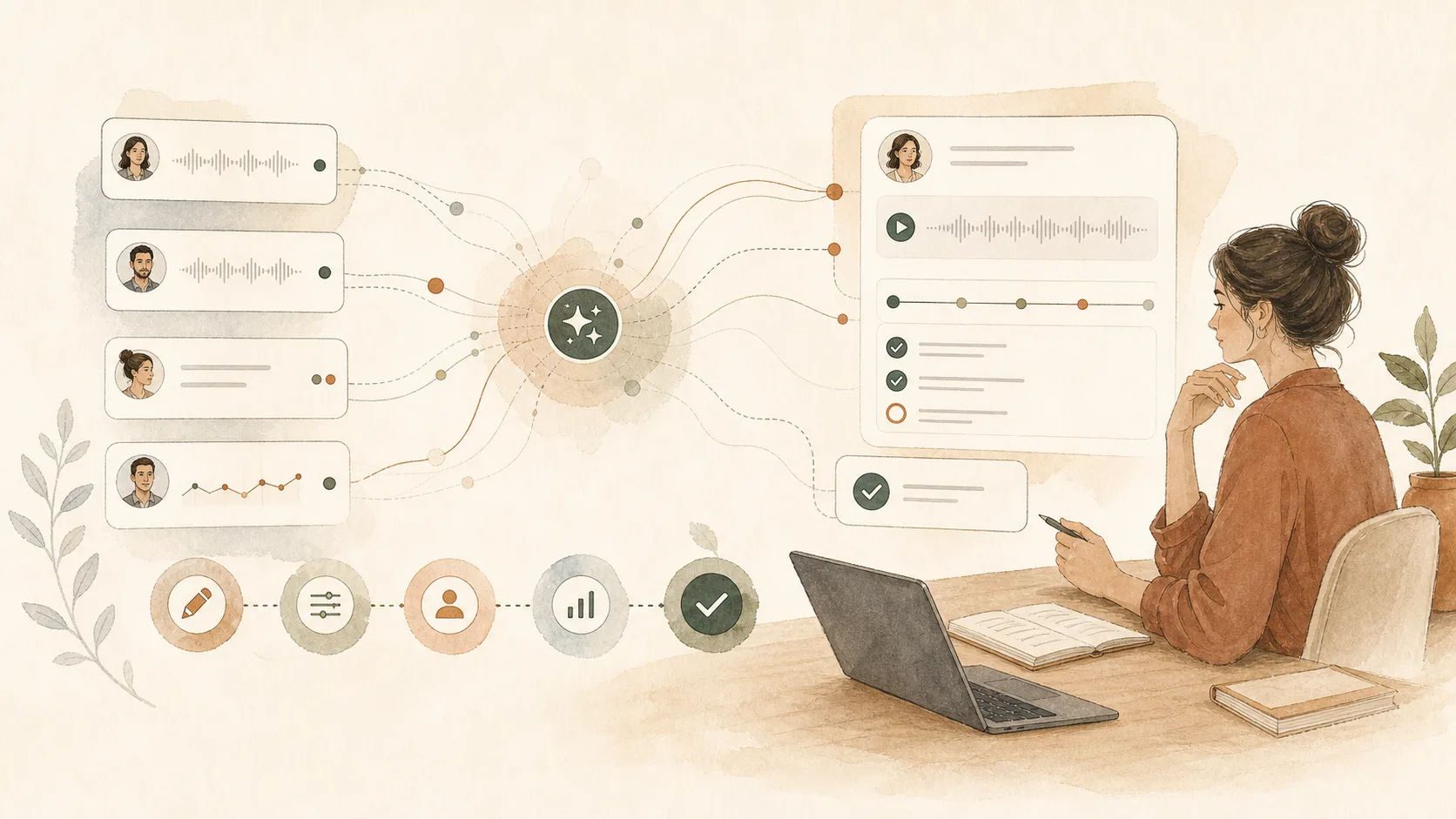
The best async coaching systems begin with a simple but well-designed client check-in.
Before the next session, the client answers a few questions by text or voice:
- What happened since the last session?
- Where did you get stuck?
- What felt different?
- What do you want help with today?
- What did you avoid?
These answers are the raw material. They replace the first ten minutes of a live call, but without scheduling, performance pressure, or time zone friction.
The check-in also changes the client. It makes them pause and reflect before receiving more content.
That alone is already part of the coaching.
The AI should prepare, not pretend
The AI should not pretend to be the coach.
It should prepare the work.
It can read the check-in, compare it to the program structure, select the right next theme, draft a personalized session, adapt an exercise, or prepare an audio script in the coach’s style.
Then the human decides what needs approval.
Some programs can run with light validation. Some sensitive programs need a practitioner to review each session. Some use a hybrid model, where the system handles routine personalization and flags cases that need human attention.
The important point is this: the AI is the delivery layer, not the authority. This is what human-in-the-loop AI coaching actually means in practice.
The authority is still the coach’s method.
Personalization has to change the session
Many tools call something personalized when it only changes the client’s first name.
That is not enough.
Real personalization changes what the client receives.
It might change the framing, the example, the exercise, the intensity, the length, the order of topics, the reminder message, or the format. One client may need a direct challenge. Another may need reassurance before they can act. Another may need a shorter session because their nervous system is already overloaded.
That is where a human method becomes scalable.
The coach defines the principles. The platform adapts the delivery.
Accountability is not optional
The biggest leak in most online programs is not the sales page. It is the silence after purchase.
Clients disappear. They miss one module, then two. They stop opening the platform. Nobody notices until the refund request or the quiet churn.
An AI coaching platform should keep the thread alive.
It should know when someone has not checked in. It should send the right kind of reminder. It should make progress visible. It should ask for a small answer before unlocking the next step.
Not aggressive automation. Not fake urgency.
Just enough rhythm to make completion more likely.
The platform should protect the creator’s time
The point is not to create another inbox.
If every client interaction becomes another manual task, the system has failed.
A strong AI coaching platform should make the creator’s time more valuable, not more fragmented. This is how you scale coaching without adding more Zoom calls. The creator should spend time on judgement: shaping the method, reviewing edge cases, improving the journey, recording or approving high-leverage content.
The machine should handle repetition.
That is the trade:
More personal for the client. Less live dependency for the coach.
The practical mobile expression of this idea is an asynchronous coaching app built around two linked experiences: a simple client space for messages, sessions, exercises, actions, and history, plus a coach review queue for context, approval, and reuse.
What to look for
If you are evaluating an AI coaching platform, ask better questions than “does it have chat?”
Ask:
- Can it collect rich client check-ins?
- Can it generate personalized sessions from a real method?
- Can a human validate the important parts?
- Can it deliver audio, text, video, or exercises?
- Can it track progress and trigger accountability?
- Can it preserve the coach’s tone and boundaries?
- Can it improve completion, not just engagement?
The best platform is not the one with the most AI features.
It is the one that helps clients finish the work and feel guided by the person they came to trust.
That is the future of AI coaching.
Not a chatbot pretending to care.
A real method, delivered personally, at a scale a human calendar could never support.