Async Coaching
Async Group Coaching and Cohorts: Community Transformation Without Live Calls
How to run high-engagement group coaching programs and masterminds asynchronously. Replace chaotic group video calls with structured peer milestones and audio hot seats.
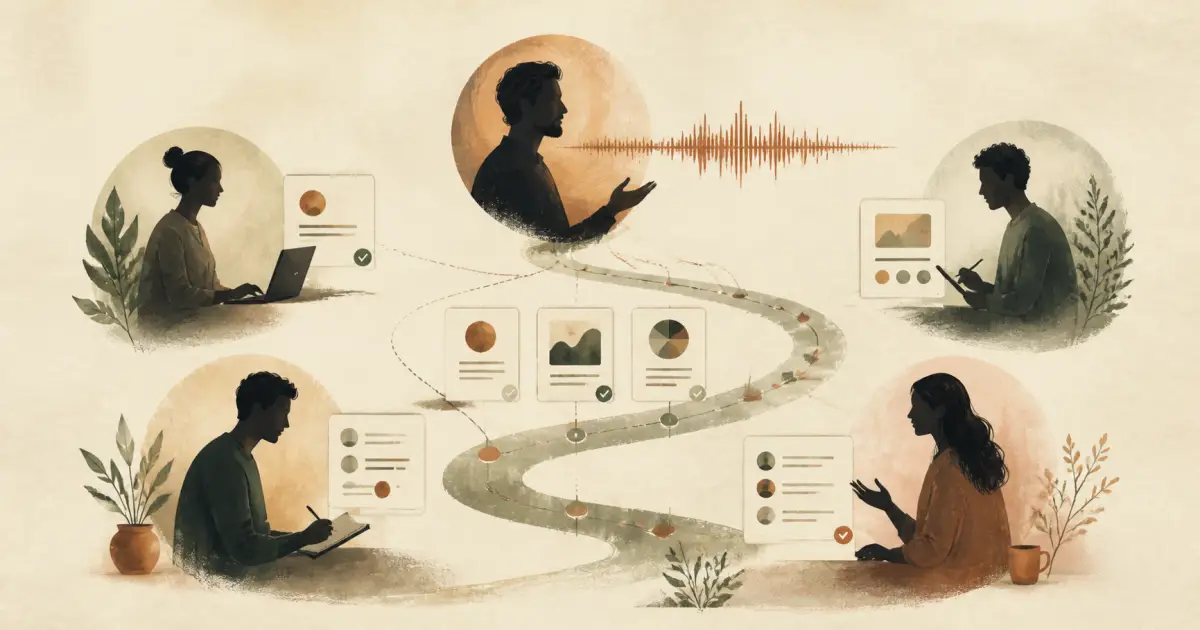
Live group coaching calls are notoriously difficult to scale.
When you pack 20 to 50 participants into a weekly 60-minute Zoom meeting, the math fails. Only three or four vocal members get to speak, quiet participants disengage, and members in incompatible time zones are relegated to watching unedited 90-minute recordings they will never finish.
Asynchronous group coaching flips this dynamic. It creates high-engagement community learning, peer accountability, and expert mentorship without requiring anyone to show up at a mandatory time.
Here is how to design and run an asynchronous cohort that gives every member a clear path to participate.
The problem with live cohort calls
In standard cohort courses and live group masterminds:
- Scheduling friction is immense: Finding a single hour that works for Europe, the Americas, and Asia is impossible.
- Participation is unequal: Extroverts monopolize the conversation while introverts remain silent.
- Passive consumption wins: Most attendees listen in the background while multitasking, absorbing little real transformation.
As we analyzed in async coaching vs online courses and cohorts, async cohorts replace mandatory attendance with mandatory implementation.
1. Synchronous rhythm, asynchronous execution
An async cohort still needs a shared calendar cadence. Everyone starts together, works on the same weekly theme, and finishes together.
The schedule operates on weekly pulses:
- Monday: The weekly framework and core assignment are released.
- Wednesday: Mid-week peer check-in where members share drafts in dedicated milestone threads.
- Thursday: Submission deadline for member questions and hot seat requests.
- Friday: The coach delivers the weekly group teardown audio brief and highlights standout student submissions.
This rhythm maintains community excitement and momentum while allowing each person to complete their deep work whenever their schedule permits.
2. Asynchronous “Hot Seats” and Teardowns
In a live call, a 15-minute hot seat helps one person while 30 other people wait passively.
In an async format, members submit a structured 2-minute breakdown of their problem alongside relevant artifacts (a sales page link, a pitch script, or a business plan).
The coach selects the 3 most universally applicable submissions and records a detailed, 5-minute audio teardown for the whole group. The entire cohort learns how to apply the principle, and the teardown becomes an evergreen asset in your coaching method library.
3. High-signal peer accountability
Open community chats (like Slack or Discord channels) quickly devolve into noisy meme sharing or complete ghost towns.
To maintain a high signal-to-noise ratio, restrict community interaction to milestone-based accountability threads:
- Create one dedicated thread per assignment (e.g., “Module 2: Post your target audience avatar here”).
- Require members to give feedback on two peers’ submissions before asking for feedback on their own.
This peer reciprocity creates genuine connection and helps members practice the frameworks on other people’s businesses or lives, reinforcing their own mastery.
4. Set capacity from your feedback promise
Do not choose cohort size from a marketing ambition. Calculate it from the feedback you promise.
For example, if you promise personal feedback to every member, estimate the average review time per submission, multiply it by the number of members and weekly submissions, then add facilitation and admin time. A group that needs more support than your review desk can sustain will feel ignored, even if the content is excellent.
Start with a small cohort, measure participation and review time for one full cycle, then raise the cap only when quality remains stable. You can price the format as a mid-tier offer according to our async coaching pricing model, between a self-paced course and private 1:1 support.
Community without calendar handcuffs
Great group coaching is not about gathering people in a virtual room to watch a screen. It is about creating a shared journey where every participant takes action, receives expert feedback, and learns from their peers.
By running your cohorts asynchronously, you eliminate timezone barriers, empower thoughtful contributors, and build a scalable group program that respects everyone’s time.
Frequently asked questions
Can group coaching work effectively without live Zoom calls? +
Yes, when the program has a shared rhythm, clear contribution prompts, and visible feedback. Async participation can make time zones and reflective styles easier to accommodate, but it still needs active facilitation.
How do you handle hot seats in an asynchronous cohort? +
Members submit their specific bottleneck in a structured template once a week. The coach reviews submissions and records a focused audio breakdown or teardown for the entire group to learn from.
How do you maintain peer accountability without a chat room becoming noisy? +
Use dedicated milestone threads instead of an open general chat. Group members only post when completing a specific assignment, keeping discussions focused and signal-to-noise ratio high.