Scalable Coaching
How to Scale Coaching Without More Zoom Calls
If your coaching business depends on live calls, growth eventually turns into calendar pressure. Async coaching creates leverage without removing the human method clients came for.
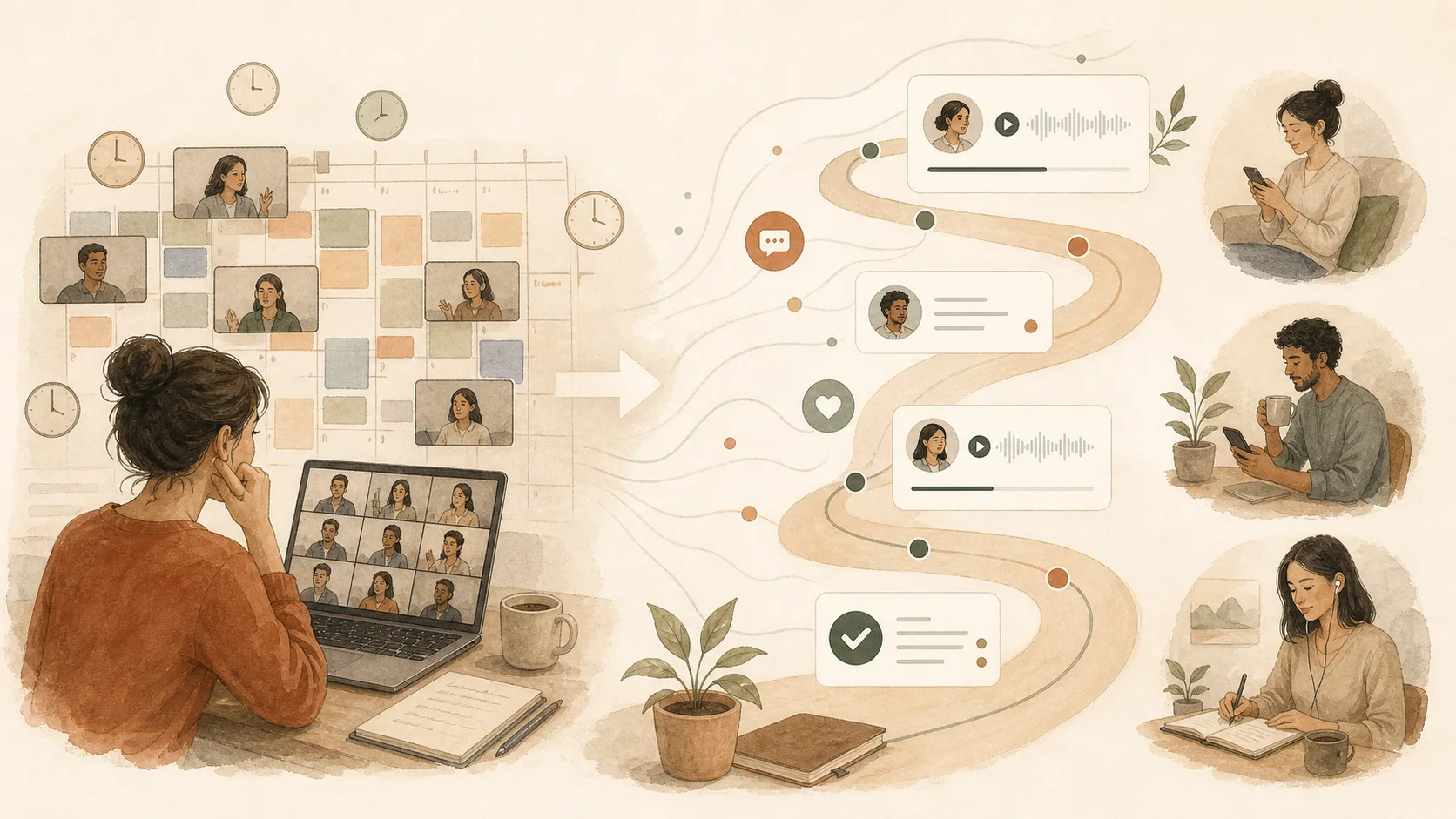
If you are a coach, therapist, educator, or creator with a method that works, scaling usually creates a painful choice.
You can stay live and personal, but your income is capped by your calendar.
Or you can package your work into a course, but the experience becomes less personal, less adaptive, and easier for clients to ignore.
Most people try to solve this by adding more Zoom calls.
Group calls. Office hours. Cohorts. Q&A sessions. Bonus calls. Accountability calls.
Sometimes that works. Often it just moves the bottleneck.
You still have to show up live. Clients still miss sessions. Time zones still create friction. Your best energy still gets sliced into calendar blocks.
The better question is not “how do I add more calls?”
The better question is:
What part of coaching actually needs to be live?
Live time is valuable, but it is not always necessary
Some moments deserve live presence. A sensitive intervention. A complex diagnosis. A hard conversation. A strategic decision where nuance matters.
But a lot of coaching work is not live because it must be live.
It is live because that was the easiest delivery format before better tools existed.
The client reports what happened. The coach reflects it back. The coach chooses the next theme. The client gets an exercise. The coach gives encouragement. The client goes away and tries to apply it.
Much of that loop can happen asynchronously.
And in some cases, it works better that way.
Async coaching starts with reflection
A live call often begins with a performance problem.
The client has to explain themselves in real time. They may try to sound clearer than they feel. They may avoid the uncomfortable part. They may use the call to process something they could have reflected on beforehand.
Async coaching changes the rhythm.
Before receiving the next session, the client answers a few focused questions. They can write. They can record a voice note. They can take two minutes or twenty. (This is where designing the client check-in does most of the work.)
This gives the coach better signal.
It also gives the client more ownership. They arrive already engaged with the work.
The session can be personalized without being live
Once the client checks in, the system can prepare the next piece of coaching.
That might be:
- A personalized audio session
- A written reflection
- A short exercise
- A video explanation
- A message in the coach’s voice
- A next-step plan based on the client’s answers
AI can help draft and adapt this material, but the method stays human. That balance is what human-in-the-loop AI coaching is built on.
The coach decides the structure, the boundaries, the tone, and the level of validation required. A good AI coaching platform handles the repetitive delivery work.
This is the key distinction.
Async coaching does not mean abandoning the client to automation.
It means designing the coaching loop so the human’s judgement is used where it matters most.
Scaling should improve completion
A lot of scaling advice focuses on revenue.
More clients. Higher margins. Less time.
All of that matters, but the deeper metric is completion.
Did clients actually do the work?
Did they come back after session one?
Did they apply the exercise?
Did they get the result they paid for?
If scaling reduces completion, it is not really leverage. It is just distribution.
Async coaching can improve completion because it creates a rhythm:
Check in. Receive the next personalized step. Apply it. Report back. Continue.
The client is not just consuming content. They are moving through a guided process.
You do not need to replace your whole offer
The easiest way to start is not to rebuild everything.
Start with the part of your offer that creates the most repetitive live work.
Maybe onboarding always takes the same 30 minutes. Maybe clients ask the same questions between calls. Maybe homework review eats your week. Maybe your course buyers need a personalized path through existing modules.
Turn one of those moments into an async loop.
Ask for the right input. Prepare the right output. Decide what needs your review. Deliver it cleanly.
Then measure whether clients continue, complete, and get better results.
The best async systems still feel human
Clients do not want a cold portal.
They want to feel guided.
That feeling comes from voice, specificity, timing, and care. It comes from receiving something that responds to their real situation. It comes from the coach’s method being present in the experience, even when the coach is not live on camera.
This is why async coaching is different from a course.
A course says, “Here is the path.”
Async coaching says, “Here is your next step on the path.”
The goal is freedom on both sides
The coach gets freedom from calendar dependency.
The client gets freedom from scheduling friction.
No rescheduling spiral. No time zone puzzle. No pressure to perform insight on a call. No need to wait a week for the next piece of support.
When designed well, async coaching gives both sides more space.
The coach can serve more people without diluting the method.
The client can move through the work in the rhythm of their actual life.
That is how coaching scales without becoming generic.
Not by adding more Zoom calls.
By building a better loop.